Blog
How to Start Learning Music Theory from Scratch
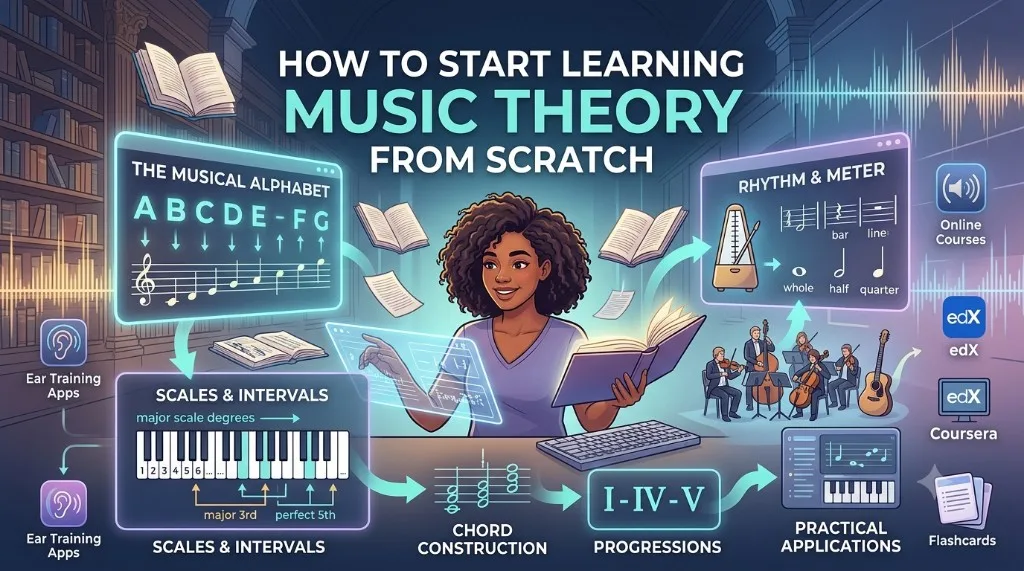
Music theory is the foundation that allows musicians to understand and create music with intention and clarity. For beginners, diving into music theory can seem daunting, but starting from scratch with a clear roadmap makes the process accessible and rewarding. This article explores what music theory entails, how to begin learning it effectively, and practical strategies for mastering its core concepts. Whether you want to compose, improvise, or simply appreciate music more deeply, understanding music theory offers valuable insights that enhance every aspect of musicianship.
Understanding Music Theory: What It Is and Why It Matters
Music theory is the study of the practices and possibilities of music. It encompasses the language and notation used to describe musical sounds, structures, and relationships. At its core, music theory explains how music works, covering elements such as scales, chords, rhythm, harmony, and form. Learning these elements helps musicians analyze existing works, create original compositions, and communicate ideas effectively with other musicians.
Unlike simply learning to play an instrument, music theory provides a framework to understand the 'why' behind the sounds. For example, knowing why a particular chord progression evokes a certain mood or why some melodies feel resolved while others sound tense can deepen your creative decisions. This theoretical knowledge also bridges genres, enabling musicians to adapt and innovate across styles.
Historically, music theory developed over centuries, evolving from simple modal systems in medieval times to the complex tonal and atonal systems of today. Modern music theory balances descriptive and prescriptive approaches, meaning it both describes how music is made and suggests ways it can be constructed. This balance allows learners to grasp established conventions and explore innovative possibilities.
For beginners, understanding the scope and boundaries of music theory is crucial. It is not a rigid set of rules but a toolkit for understanding musical relationships. This perspective encourages experimentation while providing a solid base. Starting with foundational concepts like notes, scales, and rhythm sets the stage for more advanced topics like harmony and counterpoint.
Exploring resources such as the Wikipedia page on music theory can provide a broad overview and historical context, but practical learning comes from structured study and application.
Getting Started: How to Discover and Learn Music Theory
Embarking on your music theory journey begins with choosing the right entry points and learning methods. Many beginners start by learning the musical alphabet—understanding notes, their names, and how they correspond to instruments like piano or guitar. This foundational knowledge helps you visualize and hear pitches clearly.
Next, focus on rhythm, which is the timing aspect of music. Learning to read and interpret time signatures, note durations, and rests enables you to grasp how music moves through time. Using a metronome during practice solidifies rhythmic understanding and timing accuracy.
Scales and intervals are the next logical step. Scales are ordered sequences of notes that form the basis of melodies and harmonies. Intervals measure the distance between two notes and are fundamental to building chords and recognizing melodic patterns. Practice identifying and playing major and minor scales, as they are the most common.
Many learners benefit from combining theory study with ear training, which develops the ability to recognize pitches, intervals, and chords by ear. Apps and online platforms offer exercises that progressively train your auditory skills alongside theoretical knowledge.
Structured courses, whether online or in-person, often provide guided learning paths. Popular platforms like Coursera, edX, and Berklee Online offer beginner-friendly music theory classes with practical exercises and community support. These environments help maintain motivation and provide feedback, which is crucial for steady progress.
Practical Tips to Begin Learning Music Theory
- Start with a piano or keyboard as a visual and tactile tool to understand notes and scales.
- Use flashcards or apps to memorize note names and key signatures.
- Practice clapping rhythms and counting beats aloud to internalize timing.
- Integrate ear training exercises daily to build pitch recognition.
- Set small, achievable goals like learning one new scale or chord per week.
Core Concepts and Building Blocks of Music Theory
Once the basics are in place, expanding into core concepts deepens your understanding and opens creative possibilities. These concepts include melody, harmony, chord construction, and form. Each plays a distinct role in how music is structured and perceived.
Melody is a sequence of notes that are perceived as a single entity, often the part that listeners hum or sing. Understanding how melodies are constructed using scales and intervals helps in composing or improvising memorable tunes.
Harmony involves the combination of different notes played simultaneously, producing chords. Learning how chords are built from scales, and how they function within a key, enables you to create progressions that support melodies effectively. For example, the common I-IV-V chord progression underpins countless popular songs due to its pleasing resolution.
Rhythm and meter define the temporal structure of music, dictating the flow and emphasis. Mastering rhythmic patterns and time signatures, such as 4/4 or 3/4, helps you interpret and perform music accurately.
Chord Construction and Progressions
Chords are built from stacking intervals, typically thirds, on top of a root note. Triads are the simplest chords, consisting of three notes: root, third, and fifth. Extended chords add complexity and color by including sevenths, ninths, and beyond.
Understanding chord progressions—the sequence of chords in a piece—is essential for grasping musical narrative and tension. For instance, the ii-V-I progression is a staple in jazz, creating a sense of movement and resolution.
Musical Notation and Reading Scores
Reading musical notation is a vital skill that complements theoretical knowledge. It involves recognizing symbols that represent pitch, rhythm, dynamics, and articulation. Beginners should start with the staff, clefs, note values, and basic articulation marks.
Practice sight-reading simple pieces to improve fluency. This skill not only aids performance but also enhances your ability to analyze music and communicate ideas with others.
Common Mistakes to Avoid When Learning Music Theory
Starting music theory can be overwhelming, and certain pitfalls can hinder progress or cause frustration. Awareness of these common mistakes helps maintain motivation and ensures efficient learning.
One frequent error is trying to learn too much too quickly. Music theory is cumulative; rushing through topics without solid understanding leads to confusion. Instead, focus on mastering one concept before moving on.
Another mistake is neglecting practical application. Music theory is most effective when paired with playing an instrument or composing. Without this, theory can feel abstract and disconnected from real music-making.
Overreliance on memorization without comprehension is also detrimental. Understanding why rules exist and how they function in music is more valuable than rote recall. Engage with examples and experiment to internalize concepts deeply.
Lastly, ignoring ear training limits your ability to apply theory intuitively. Developing aural skills is essential for recognizing intervals, chord qualities, and rhythmic patterns in real music.
Practical Applications: Using Music Theory in Real-World Scenarios
Music theory is a powerful tool when applied to everyday musical activities. Whether composing, improvising, or analyzing songs, theoretical knowledge enhances creativity and communication.
For songwriters, understanding chord progressions and scales can guide melody creation and harmonic support. For example, knowing that the pentatonic scale fits over many blues progressions allows for effective soloing and riff crafting.
Improvisers use music theory to navigate chord changes and create coherent solos. Jazz musicians often rely on modes and altered scales to add color and tension in their improvisations.
Educators and students benefit from music theory as a framework for teaching and learning music systematically. It provides vocabulary and concepts that facilitate discussion and critique.
Analyzing existing compositions through a theoretical lens reveals how composers achieve emotional effects, structural balance, and thematic development. This insight informs your own creative decisions and deepens appreciation.
Step-by-Step Guide to Applying Music Theory
- Identify the key of the piece or segment you are working on.
- Determine the scale and chords commonly used in that key.
- Experiment with creating melodies using the scale notes.
- Build chord progressions that complement the melody and create desired moods.
- Practice improvisation using scales and arpeggios relevant to the chords.
- Analyze recordings or scores to see these principles in action.
Frequently Asked Questions About Learning Music Theory

Is it necessary to learn music theory to play an instrument?
While not strictly necessary, learning music theory significantly enhances your ability to understand, interpret, and create music. It provides tools to read notation, compose, and improvise effectively, making it easier to progress beyond basic playing.
How long does it take to learn music theory from scratch?
The timeline varies depending on your goals, practice frequency, and prior musical experience. Basic concepts can be grasped in a few weeks of consistent study, but mastering advanced topics and applying theory fluently typically takes months or years of ongoing learning and practice.
Can I learn music theory without an instrument?
Yes, theoretical knowledge can be learned through books, courses, and apps without playing an instrument. However, having an instrument to apply concepts practically improves understanding and retention, making the learning process more engaging and effective.
What are the best resources for beginners learning music theory?
Beginner-friendly resources include online platforms like musictheory.net, Coursera’s music theory courses, and textbooks such as “The Complete Idiot’s Guide to Music Theory.” Combining these with practical tools like a piano keyboard and ear training apps yields the best results.
For further reading on foundational concepts, consult the comprehensive overview available at Wikipedia's music theory page.
Grow your music school with intent
Practice guidance, theory foundations, and acquisition funnels work best with a clear playbook. Explore our music school marketing services or browse more guides in the music education blog.
Turn insights into measurable growth
Book a strategy conversation with Pont Digital. We help startups and SMBs across Canada and the U.S. with SEO, leads, and conversion-focused marketing.