Blog
The Differences Between Learning with a Teacher and Taking Online Music Courses
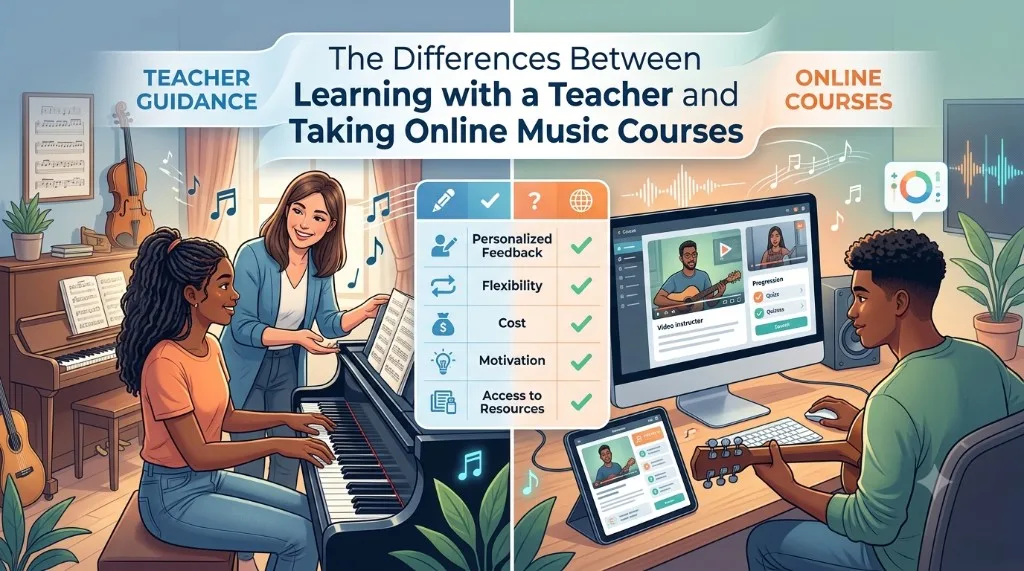
Choosing how to learn music is a pivotal decision for aspiring musicians and hobbyists alike. The rise of online music courses has transformed access to music education, offering a flexible alternative to traditional in-person lessons with a teacher. Understanding the differences between learning with a teacher and taking online music courses is essential to making an informed choice. This article explores the advantages and drawbacks of both methods, helping you decide which approach aligns best with your learning style, goals, and schedule.
Learning with a Teacher: Personalized Guidance and Real-Time Feedback
Learning music with a teacher typically involves one-on-one or small group sessions led by an experienced instructor. This traditional approach offers direct interaction, allowing for immediate feedback, tailored lesson plans, and nuanced adjustments based on the student's progress. One of the core benefits is the customized attention that a teacher provides, identifying weaknesses and strengths and adapting teaching strategies accordingly.
For example, a piano student struggling with hand positioning will receive instant correction, preventing the formation of bad habits. Moreover, teachers often motivate students through personal encouragement and accountability, which can be crucial in maintaining consistent practice routines.
However, learning with a teacher can have logistical challenges, such as scheduling conflicts and location constraints. The cost is another consideration; private lessons often demand a higher financial investment than online alternatives. Despite these factors, the depth of personalized learning and emotional connection with a teacher remains unmatched in many cases.
Pros of Learning with a Teacher
- Real-time, personalized feedback: Immediate corrections help refine technique and prevent errors.
- Customized lesson plans: Instruction adapts to individual skill levels and goals.
- Motivation and accountability: Teachers encourage practice and progress through direct interaction.
- Opportunity for ensemble playing and live performance: Teachers can facilitate group activities and recitals.
Cons of Learning with a Teacher
- Higher cost: Private lessons can be expensive and often require ongoing payments.
- Scheduling constraints: Fixed lesson times may conflict with busy or unpredictable schedules.
- Limited geographic accessibility: Finding qualified teachers nearby can be challenging in some areas.
- Variability in teacher quality: Finding the right teacher fit requires research and sometimes trial and error.
Taking Online Music Courses: Flexibility and Broad Access
Online music courses have surged in popularity, offering an accessible and often affordable way to learn music remotely. These courses range from pre-recorded video lessons to interactive platforms with quizzes, assignments, and community forums. They cater to a wide array of instruments, styles, and skill levels, making it easy for learners to explore new interests or deepen existing skills.
The primary advantage of online music courses is flexibility. Students can learn at their own pace, revisiting difficult concepts multiple times and fitting lessons around their schedule. For instance, a working professional can practice guitar lessons late at night, while a student can pause and replay complex finger exercises as needed. Platforms like Coursera, Udemy, and dedicated music education sites provide structured curriculums that replicate classroom learning digitally.
That said, online courses lack the immediacy of live feedback from an instructor. Some platforms mitigate this by offering live Q&A sessions or optional coaching calls, but the experience is generally less personalized. Self-discipline is crucial to progress, as the absence of direct accountability can lead to inconsistent practice. Additionally, without a teacher’s guidance, students might develop improper techniques or misunderstand theoretical concepts.
Pros of Taking Online Music Courses
- Convenience and flexibility: Learn anytime, anywhere, accommodating busy lifestyles.
- Wide variety of courses: Access to diverse instruments, genres, and teaching styles globally.
- Cost-effective options: Many courses are free or significantly cheaper than private lessons.
- Self-paced learning: Ability to revisit lessons and learn at your own speed.
Cons of Taking Online Music Courses
- Lack of personalized feedback: Limited real-time corrections can hinder progress.
- Requires high self-motivation: No direct accountability may reduce practice consistency.
- Potential for developing bad habits: Without correction, improper techniques may go unnoticed.
- Less opportunity for ensemble or live performance experience: Interaction is often limited to forums or virtual meetups.
Comparison of Learning with a Teacher vs. Online Music Courses
To clarify the distinctions, the following table summarizes key features, pros, and cons of both learning options. This comparison helps highlight which factors might weigh more heavily depending on individual circumstances.
| Feature | Learning with a Teacher | Online Music Courses |
|---|---|---|
| Personalized Feedback | Immediate, tailored corrections | Limited or delayed feedback |
| Flexibility | Fixed lesson times | Learn anytime, self-paced |
| Cost | Higher, ongoing expense | Generally lower, one-time or subscription |
| Motivation | Teacher-driven accountability | Requires self-discipline |
| Access to Resources | Depends on teacher’s materials | Extensive digital resources and communities |
| Performance Opportunities | Live recitals and ensembles | Limited, mostly virtual |
This table shows that while teachers excel in personalized support and motivation, online music courses offer unmatched convenience and resource availability. The choice depends largely on the learner’s needs, budget, and learning style.
When to Choose Learning with a Teacher
Opting for a teacher is ideal when personalized guidance is crucial, such as for beginners needing strong foundational skills or advanced students pursuing mastery. For example, classical piano students often benefit from a teacher’s nuanced feedback on technique and interpretation that online courses cannot fully replicate.
Additionally, learners who thrive on direct interaction and external accountability will find lessons with a teacher motivating. If your schedule allows consistent attendance and you value live performance opportunities, this method is advantageous. Teachers also help navigate complex musical theory and adapt quickly if students face learning plateaus.
Real-World Use Case
Consider Maria, a 12-year-old violin student preparing for conservatory auditions. Her teacher identifies subtle intonation issues and adjusts exercises weekly, accelerating her progress. The structured environment and live recitals build her confidence and stage presence, crucial for her goals.
When to Choose Online Music Courses
Online music courses are best suited for self-motivated learners who need flexibility due to busy schedules or geographic constraints. For instance, adults balancing work and family commitments can fit lessons into their own time, making steady progress without the pressure of fixed appointments.
Additionally, if you want to explore multiple instruments or genres without committing to costly private lessons, online courses provide a broad, affordable starting point. They are also ideal for supplementing traditional lessons with extra practice materials or theory instruction.
Real-World Use Case
John, a software engineer, uses online music courses to learn guitar during evenings. He appreciates the ability to pause and replay lessons on fingerpicking techniques, progressing at his own pace. While he misses live feedback, he compensates by recording himself and comparing to course examples.
Common Pitfalls and How to Avoid Them
Regardless of the chosen method, learners face challenges that can hinder progress. For those learning with a teacher, one common pitfall is passivity—relying too much on the instructor and neglecting independent practice. To avoid this, set clear practice goals and maintain open communication about progress and difficulties.
Online learners often struggle with motivation and consistency. Without scheduled lessons, it’s easy to skip practice sessions. Creating a dedicated practice schedule and joining online communities or study groups can help maintain accountability.
Another frequent issue in online courses is misunderstanding complex concepts due to lack of immediate clarification. To mitigate this, select courses with interactive components like live Q&A, or supplement with occasional private coaching sessions.
Advanced Insights: Combining Both Approaches
Many successful musicians blend both learning modes, leveraging the strengths of each. For example, a student might take weekly lessons with a teacher for personalized feedback while using online music courses for supplementary theory, ear training, or exploring new genres.
This hybrid approach maximizes flexibility and depth of learning. It also allows learners to manage costs by reducing private lesson frequency without sacrificing quality. Platforms like TrueFire or ArtistWorks offer options to combine online courses with instructor feedback, bridging the gap between the two methods.
According to music education research, blended learning models often yield higher engagement and retention, especially when students actively apply knowledge between sessions.
Recommendation: Choosing the Best Option for You
Ultimately, the decision between learning with a teacher and taking online music courses depends on your goals, budget, learning style, and availability. If you seek deep, personalized instruction and thrive with direct interaction, a teacher is the recommended option. This is especially true for beginners or serious musicians preparing for performances or exams.
Conversely, if flexibility, cost-effectiveness, and access to diverse materials are your priorities, online music courses offer a compelling solution. They work best for motivated learners comfortable with self-directed study and who value convenience.
For many, a hybrid approach combining both methods provides the most comprehensive learning experience. Starting with online courses to build fundamentals, then adding a teacher for refinement and motivation, can balance affordability and quality effectively.
Before committing, consider trial lessons or free online course previews to gauge which format fits your preferences. Remember, consistent practice and passion remain the most critical factors in musical success, regardless of the learning path chosen.
Grow your music school with intent
Practice guidance, theory foundations, and acquisition funnels work best with a clear playbook. Explore our music school marketing services or browse more guides in the music education blog.
Turn insights into measurable growth
Book a strategy conversation with Pont Digital. We help startups and SMBs across Canada and the U.S. with SEO, leads, and conversion-focused marketing.